
Yes, you can overseed without aerating – but only if you stop pretending grass seed can magically grow on concrete. If you understand how to overseed lawn without aerating the right way, you can thicken your turf without turning your yard into a construction site. Do it wrong, and you’re just feeding birds.
TL;DR
Yes, you can overseed without aerating – but only if you stop pretending grass seed can magically grow on concrete. If you understand how to overseed lawn without aerating the right way, you can thicken your turf without turning your yard into a construction site. Do it wrong, and you’re just feeding birds.
Every spring someone tells me they want to overseed, but they don’t want to aerate. Too messy. Too much work. Too many weird holes in the lawn. Fair enough – not everyone wants their yard looking like it just lost a bar fight.
But here’s the reality: grass seed doesn’t grow on wishful thinking. It grows when it touches soil, stays moist, and gets air. Aeration helps with that, but it’s not the only way to make it happen.
If you’re serious about learning how to overseed lawn without aerating, you need to understand what aeration actually does – and how to replace its effects.
Why aeration usually matters
Aeration isn’t some fancy lawn-care ritual. It punches holes in compacted soil so air, water, and roots can move. Without it, soil stays hard, water runs off, and seed never makes real contact with the ground.
When people overseed without aerating and fail, it’s not because aeration is sacred. It’s because they skipped the part where seed actually meets soil.
That’s what you need to recreate.
The real enemy: compacted soil
Most lawns don’t fail at overseeding because of bad seed. They fail because the surface is sealed like asphalt. Thatch, dead grass, and compacted soil create a barrier that new roots simply can’t break through.
So if you’re skipping aeration, you have one job: open that surface.
Raking isn’t optional
I don’t mean leaf raking. I mean aggressive, borderline rude raking. You want to rip out dead grass, break up thatch, and expose soil. The uglier it looks afterward, the better your odds.
If you can’t see soil, the seed has nowhere to go.
This step alone replaces half the benefit of aeration when it comes to overseeding.
Getting seed into the ground without holes
Once the lawn is opened up, you have to make sure the seed doesn’t just sit on top.
This is where most people blow it.
They throw seed, admire their work, and walk away. A week later it’s gone – eaten, dried out, or washed away.
You need to work it in.
Use the back of a rake, a lawn roller, or even your boots to press seed into the loosened surface. You’re not burying it – you’re tucking it into tiny cracks and pockets where moisture and soil touch it.
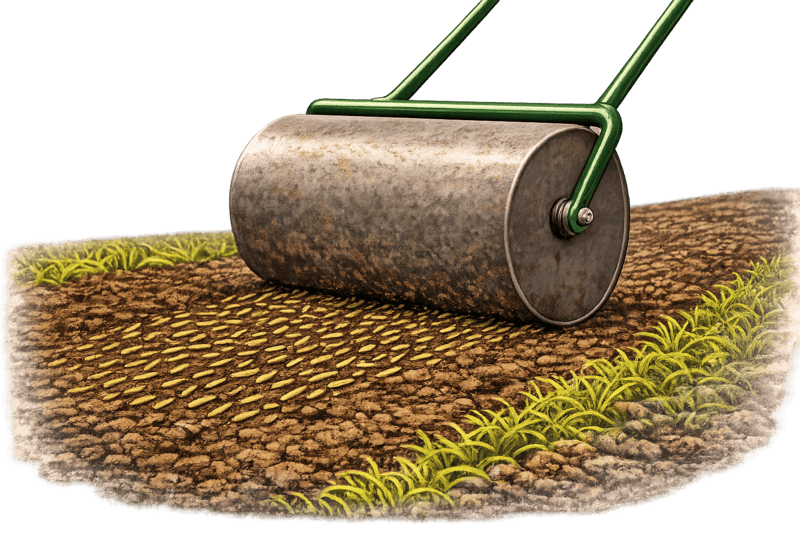
That’s how grass starts.
Topdressing: the secret weapon
If I had to choose one trick for how to overseed lawn without aerating, this would be it.
A thin layer of compost or fine soil over the seed does three things at once:
- Holds moisture
- Keeps birds away
- Anchors seed to the ground
You don’t need much – just enough to lightly cover the seed. Too much and you suffocate it. Too little and it dries out.
This is where patience beats enthusiasm.
Water like you mean it
New seed is fragile. Let it dry out once and you set it back days.
For the first couple of weeks, the surface must stay lightly moist. That means gentle watering, often. Not puddles. Not floods. Just enough to keep the top layer damp.
Once the grass is up, back off and let roots grow down.
When this method actually works
Skipping aeration works best when:
- Your soil isn’t severely compacted
- You’ve raked properly
- You use topdressing
- You keep things moist
It won’t fix a lawn that’s basically concrete. But for thinning grass, light damage, and general thickening, it works surprisingly well.
Common mistakes I see every year
People overseed without aerating and then:
- don’t rake
- don’t press seed in
- don’t cover it
- don’t water consistently
And then they say it “doesn’t work.”
It does. They just didn’t do it.
Is aeration still better?
Yes. Most of the time. But not everyone needs it every year, and not everyone wants it. If you know what you’re replacing – air, contact, and space – you can get good results without punching holes in your yard.
That’s what how to overseed lawn without aerating really means: not skipping the work, just doing it differently.
Kaboo’s final word
If your seed touches soil, stays damp, and gets air, it will grow. Aeration is just one way to make that happen. Raking, pressing, and topdressing are another. Choose the method — just don’t skip the fundamentals.